
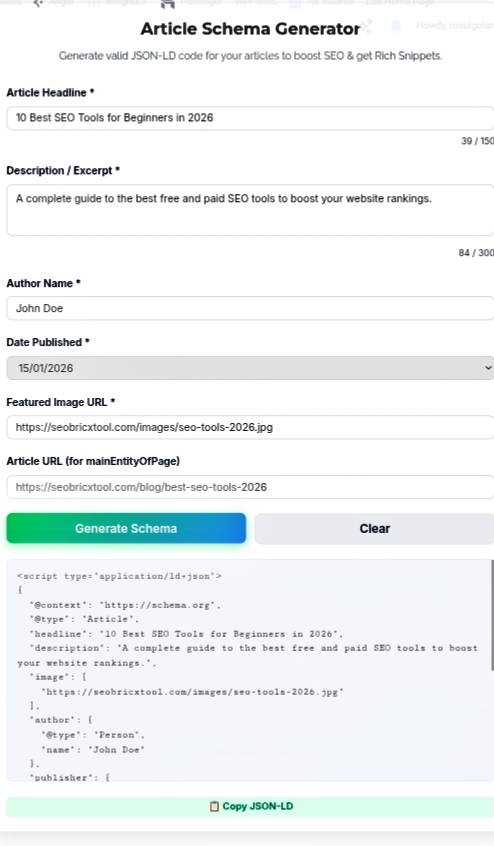
Here’s the brutal truth about blogging in 2026: writing a great post is only half the war. The other half? Making sure Google actually understands what you wrote, who wrote it, and why anyone should care. You could have the most brilliant article on the planet, but if search engines can’t parse the context, you’re basically invisible. That’s where the Article Schema Generator comes in. It injects professional metadata into your site — authorship, publish date, featured image, the works — so Google knows exactly what it’s looking at. And if you’re aiming for Google News or those juicy Rich Snippets? This isn’t optional. It’s mandatory.
What Standard HTML Completely Misses
Look, a regular HTML page gives Google a title and maybe a meta description. That’s it. No nuance. No context. No proof that you’re a real person writing real content. Structured data changes everything.
Authorship — Google can now verify who actually wrote this. “John Doe” isn’t just text on a page; it’s a verified entity. This feeds directly into E-E-A-T — Experience, Expertise, Authoritativeness, Trustworthiness. I’ve seen sites get traffic boosts just from properly marking up their authors. Google trusts verified humans more than anonymous content farms. Shocking, I know.
Publish date — Crucial for anything time-sensitive. News, tutorials, product reviews — users need to know if your info is from last week or 2019. I’ve clicked on “latest SEO tips” only to realize the post was three years old. Frustrating. Schema prevents that mismatch.
Featured images — Without schema, Google picks whatever image it feels like. Usually the wrong one. With Article Schema, you dictate exactly which thumbnail shows up in search results. Visual appeal matters. A good thumbnail can be the difference between a click and a scroll-past.
Google Discover and News — The Big Leagues
If you’re serious about traffic, you want Google Discover and Google News. We’re talking millions of impressions. But here’s the catch: they’re picky. Article Schema has to follow Google’s guidelines to the letter. One missing field, one formatting error, one broken URL — and you’re disqualified. No warnings, no second chances.
I learned this the hard way. Spent weeks optimizing a news site, submitted to Google News, got rejected because our schema had a syntax error. One tiny missing comma. A specialized generator would have caught that instantly. Now? I never submit without running schema through a generator first. Non-negotiable.
How to Actually Implement This
Generate your JSON-LD code, paste it into the section of your HTML template. Sounds simple, but don’t skip the testing step. Google’s Rich Results Test tool is free and takes thirty seconds. Run your code through it. Fix any errors. Then go live.
I’ve seen too many people generate perfect schema, paste it in, and never test it. Then they wonder why their Rich Snippets aren’t showing. The tool catches syntax issues, missing required fields, formatting problems — all the stuff that silently breaks your chances. Use it. Every single time.
My Honest Take?
Structured data isn’t some nerdy developer thing anymore. It’s the language the modern web speaks. Every article you publish without schema is an article that could have reached more people but didn’t. The Article Schema Generator removes every excuse — no coding knowledge needed, no syntax anxiety, no broken commas. Just fill in the fields, copy the code, paste it in. Done. In a world where attention is the scarcest resource, this is how you make sure your content actually gets seen.
Go schema-up your next article before you hit publish. Future you will be grateful. https://seobricxtool.com/4878-2/
