
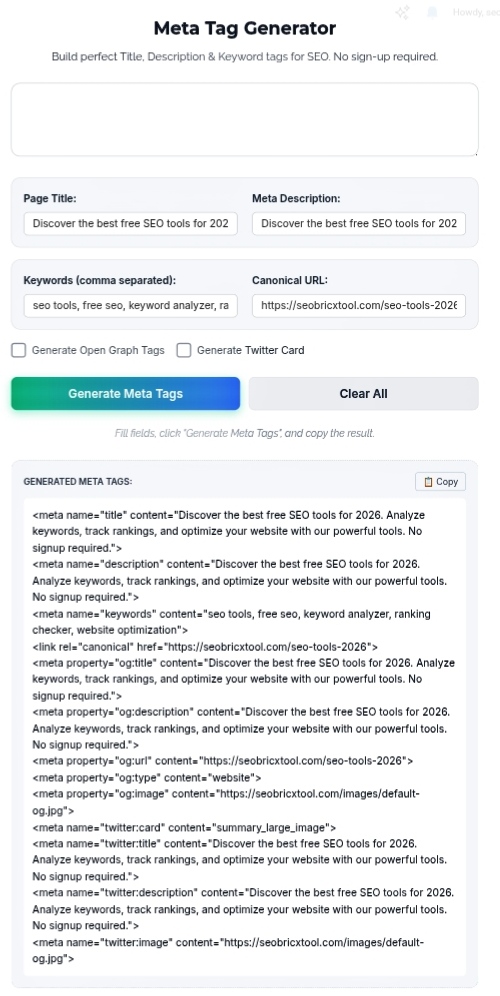
Let’s be real — meta tags are boring. Like, genuinely unsexy SEO stuff that nobody wants to think about. But here’s the thing: they’re also one of the highest-leverage things you can fix on your site. Those tiny snippets of HTML code? They’re literally your digital storefront. The headline and description that convince someone to click — or scroll past. Get them wrong and you’re invisible. Get them right and you steal traffic from competitors who couldn’t be bothered. The Meta Tag Generator is how you nail this without touching a single angle bracket yourself.What Are Meta Tags, Actually?Meta tags are hidden HTML elements that tell search engines and social platforms what your page is about. Users never see them directly, but they determine everything about how your content appears in search results.Title tag — The blue clickable headline in Google. Arguably the strongest on-page SEO signal you have. I’ve seen rankings shift just from rewriting a title tag. Not kidding.Meta description — The grey text below your title. Not a direct ranking factor, but absolutely critical for CTR. A compelling description can double your click-through rate. A boring one? Crickets.Meta keywords — Google ignores these now. Has for years. But some smaller search engines still peek at them. Takes two seconds to add, so why not?Open Graph & Twitter Cards — Modern web means social sharing matters. OG tags control how you look on Facebook and LinkedIn. Twitter Cards do the same for Twitter/X. Our generator handles all of them automatically because doing it separately is a pain I wouldn’t wish on anyone.Why Bother With a Generator?Manual meta tags are a minefield. Proper formatting, character limits, keyword placement, platform-specific variations — mess up any of it and you’re worse off than having no tags at all. I’ve broken pages by forgetting to close a quote in a meta tag. Embarrassing.The generator fixes all of this:Automated syntax — Correct HTML formatting every time. No broken quotes, no missing brackets.Real-time preview — See exactly how your title and description will look in actual search results before you publish. No more “hope for the best.”Character counting — Live tracking so you know when you’re approaching Google’s limits. ~60 characters for titles, ~160 for descriptions. Go over and you get truncated. Looks amateur.Platform optimization — Standard SEO tags plus social media tags in one shot. One tool, all outputs.No signup — Just use it. No accounts, no emails, no “verify your identity” nonsense.How I Actually Use ThisStep 1: Fill in the basics — Page title (50-60 chars, keyword near the front), meta description (under 160, compelling, maybe a CTA), relevant keywords, canonical URL.Step 2: Social options — Check “Generate Open Graph Tags” for Facebook/LinkedIn. Check “Generate Twitter Card” for Twitter/X. Both if you’re serious about shares.Step 3: Generate and deploy — Hit the button, get clean HTML, paste into your <head> section. Takes under a minute. I’ve timed it.Rules That Actually WorkTitles — Primary keyword first, unique per page, actionable or intriguing. “Best SEO Tools for 2026” beats “SEO Tools Page” every time. Write for humans, optimize for bots. Not the other way around.Descriptions — Clear value proposition, active voice, strong verbs. “Learn how to rank higher” beats “This page is about SEO.” Include a CTA when it makes sense. “Get started,” “Learn more,” “Discover why.”Keywords — Long-tail over broad. “best free SEO tools for beginners” beats “SEO tools.” Match user intent. Don’t stuff. Google penalizes that now.Mistakes I’ve Made (So You Don’t Have To)Duplicate titles — Every page needs its own. I once had five pages with the same title. Google was confused. Rankings tanked. Don’t be me.Missing tags entirely — Search engines just guess. Usually badly. Your “About Us” page shows up with sidebar widget text as the description. Not a good look.Going too long — Truncated text looks broken. “Best SEO Tools for Bloggers in 2…” tells nobody anything. Stay within limits.Ignoring mobile — Over half of searches happen on phones. Your carefully crafted 60-character title might show as 40 on mobile. Front-load the good stuff.Forgetting social tags — Your link gets shared, looks like garbage. No image, weird description, random text. Social traffic dies before it starts.Who Actually Needs This?Bloggers — Every post needs unique, optimized tags. Manual creation for 50 posts? Torture. Generator makes it manageable.E-commerce — Hundreds of product pages, each needing distinct meta content. Scale matters.Local businesses — Location-specific keywords in titles and descriptions. “Best Pizza in Brooklyn” not just “Pizza Restaurant.”Developers — Client projects need standardized meta structures. Generate fast, implement faster.Students — Learning SEO hands-on without breaking things. Safe practice environment.My Honest Take?Meta tags are your first impression. Your digital handshake. Your three-second pitch to every potential visitor. Getting them right isn’t optional — it’s survival in search. The Meta Tag Generator removes every barrier: no coding, no guessing, no formatting anxiety. Just fill, preview, generate, paste. Professional-grade SEO in under a minute. In a world where everyone’s fighting for the same clicks, this is how you actually get noticed.
Go optimize your meta tags before your next competitor does. https://seobricxtool.com/5599-2/
