Back when SEO first took off, ranking your site was basically a game of stuffing keywords everywhere you could. If you wanted to show up for “coffee beans,” you’d cram that phrase into every sentence. These days, Google’s smarter, and that old trick just gets your site flagged. Still, keyword density—the idea of balancing how often you use a key term without overdoing it—matters if you want your writing to hit both search engines and actual readers.
So, what’s keyword density, exactly? It’s just a percentage. Say your article’s got 100 words, and “marketing” pops up three times? That’s a 3% keyword density. Google’s algorithms now understand nuance way better thanks to stuff like BERT and MUM. But sticking to a reasonable density still gives search bots a signal: “Hey, this page is actually about this topic.”
Let’s talk about keyword stuffing for a sec. Nothing turns people off faster than stiff, unnatural writing. If you stick “coffee beans” into every single line, readers bail. Google notices those bounce rates and ends up pushing you lower in the results. A good keyword density tool helps you land in the sweet spot—enough to please the algorithm, not enough to drive away real people.
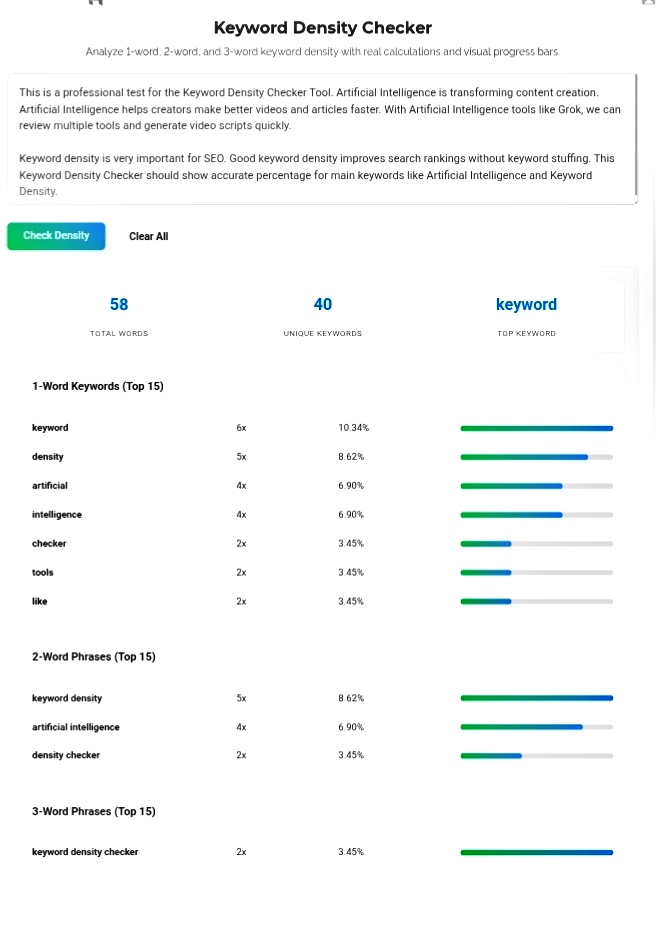
Don’t just focus on single words, either. Dig into phrases. Two-word combinations (bigrams) and three-word combos (trigrams) are where you really start seeing useful patterns:
Progress bars, percentages—they let you quickly spot if you’re covering the right terms instead of just echoing the same word over and over.
A few practical tips:
At the end of the day, optimization isn’t just about gaming a search engine. It’s about making information easy to find for everyone—robots and humans alike. When you use density tools the right way, your content stays sharp, readable, and ready to compete.
Take a look at your drafts now and sharpen up your strategy. https://seobricxtool.com/4829-2/