
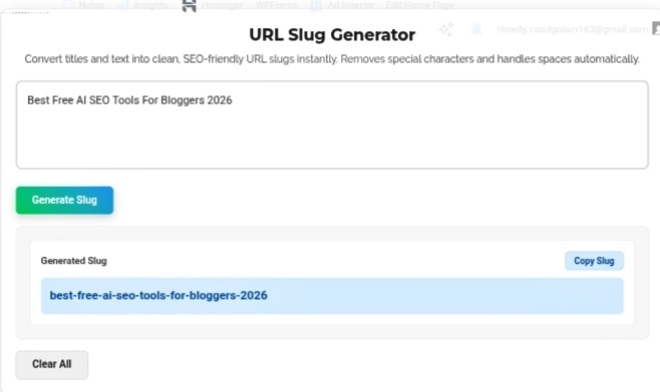
Here’s something most bloggers completely ignore — and it costs them traffic every single day. You’re writing an amazing post, optimizing headlines, picking the perfect images… but then you hit publish and your URL looks like www.site.com/blog/post?id=123&cat=tech . A complete mess. Nobody wants to click that. Not Google. Not your readers. Nobody. That’s where the URL Slug Generator comes in — it takes your ugly title and spits out a clean, readable address that actually makes sense.
Wait, What Even Is a Slug?
Okay, real quick. The “slug” is just the part after your domain name. Simple, right? But most people mess this up badly.
Bad: example.com/How-To-Build-A-Website-Using-HTML!
Good: example.com/how-to-build-a-website-using-html
See the difference? The second one is what we call a “clean URL.” Search engine bots can actually read it. Humans can too — they know exactly what they’re getting before they click. The first one? It looks spammy, broken, or just lazy. Trust me, I’ve clicked away from links just because the URL looked sketchy. Your visitors do the same.
The Headaches It Actually Fixes
Doing URLs by hand is a nightmare. I’ve been there — copying a title, pasting it in, realizing there’s a weird symbol somewhere, fixing it, breaking something else… ugh. A good slug generator handles all of this automatically:
- Lowercase everything. URLs are case-sensitive, which is honestly stupid but true. Page-One and page-one are technically different pages. One works, one throws a 404. Sluggers just force lowercase and call it a day.
- Killing special characters. Spaces, question marks, hashtags, ampersands, exclamation points — all of them break links. Sluggers strip these out completely. No more broken URLs because you used an apostrophe in your title.
- Hyphens instead of spaces. Spaces become hyphens (or underscores, but honestly? Google prefers hyphens). So “best seo tools” becomes best-seo-tools . Clean, readable, keyword-friendly.
- Optional stop word removal. Some advanced tools let you drop words like “and,” “the,” “for” to keep things short. Not essential, but nice to have when your title is a paragraph.
Why Google Actually Cares About This
Look, Google has straight up said that site structure matters for ranking. It’s not some secret — they literally tell us this. Clean URLs help in ways you might not think about:
Readability = trust. When someone sees a URL like yoursite.com/best-url-slug-generator , they feel safe clicking it. It looks legit. Professional. Not some phishing trap.
Keywords in the URL. Including your main keyword in the slug reinforces what your page is about. /seo-tools tells Google “this page is about SEO tools” before the crawler even reads your content.
Mobile matters. Long, convoluted URLs are a pain to tap on phones. Short, clean slugs? Easy. In a world where 60%+ traffic is mobile, this absolutely matters.
My Actual Workflow
Before I publish literally anything, I run the title through a slug generator. Every. Single. Time. It takes maybe 3 seconds. Then I double-check that the final URL actually matches what the article is about. Consistency here isn’t sexy, but it pays off. I’ve seen organic traffic grow month over month just from cleaning up URLs on old posts. Small fix, big results.
Bottom Line
Technical SEO sounds intimidating, but this isn’t. A slug generator is one of those “set it and forget it” tools that quietly protects your site from broken links and slowly pushes you up the rankings. Spend 3 seconds now, save yourself hours of headaches later. That’s the kind of trade-off I always take.
Clean up your URLs before your next post goes live. https://seobricxtool.com/4856-2/
