
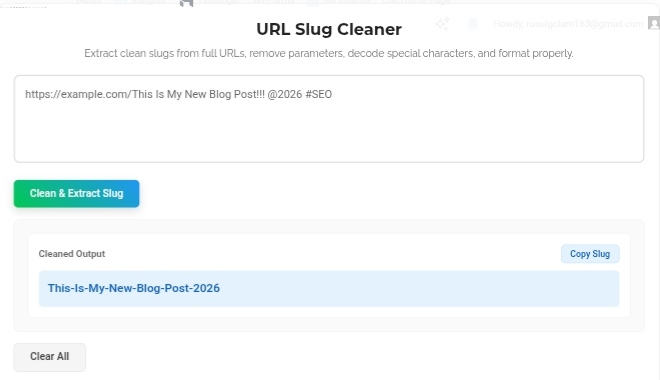
Let’s talk about something nobody wants to admit — your URLs might be absolutely terrible. Like, actively hurting your website terrible. You’ve spent hours writing killer content, optimizing images, tweaking meta tags… but then someone copies your link and it looks like https://example.com/page?cat=blog&id=123&sort=new!! . A complete disaster. Search engines hate it. Users don’t trust it. And honestly? It makes your whole site look amateur. That’s exactly why a URL Slug Cleaner isn’t just nice to have — it’s basically mandatory if you care about looking professional online.
What Does “Clean” Even Mean Here?
Okay, so what separates a good URL from a bad one? It’s not rocket science, but most people get this wrong anyway. A clean URL is lowercase, uses hyphens between words, and actually tells you what’s on the page before you click. No random parameters. No special characters. No screaming capital letters.
Bad: https://example.com/page?cat=blog&id=123&sort=new!!
Good: https://example.com/best-seo-tools-for-bloggers-2026
See the difference? The second one is instantly readable. Both Google and your visitors know exactly what they’re getting. The first one? It looks like your cat walked across the keyboard. A URL Slug Cleaner takes that mess and automatically fixes it — stripping out question marks, ampersands, weird spaces, and random capitalization. What you get back is something that actually belongs on a professional website.
The Tech Stuff (But I’ll Keep It Simple)
I know “technical SEO” sounds intimidating. But this part is genuinely straightforward. Google absolutely uses URL structure as a ranking signal — not the biggest one, but it matters. When you paste a messy URL into a cleaner, here’s what actually happens behind the scenes:
- Decoding weird characters. Ever see %20 in a URL? That’s just a space, encoded. The cleaner converts these back to readable text or replaces them with hyphens. Suddenly your link looks human again.
- Killing tracking parameters. Those utm_source and utm_medium tags? Useful for analytics, terrible for clean links. The cleaner identifies and strips them out. Your URL becomes shareable without looking like a tracking nightmare.
- Hyphens over underscores. This one trips people up constantly. Google treats hyphens as word separators ( best-seo-tools = three words). Underscores? They get treated as connectors ( best_seo_tools = one weird word). The cleaner forces hyphens every time. No thinking required.
Where People Actually Use This
Migrating content — Moving your entire site to a new domain? Nightmare scenario if your URLs are messy. Clean them first, set up proper redirects, and save yourself hours of 404 headaches later.
Database management — Developers deal with export files full of ugly URLs all the time. Running them through a cleaner before importing keeps everything matching perfectly. No broken references. No data mismatches.
Guest posting & link building — Before you send that pitch email with your link, check if it’s clean. A messy URL in a professional outreach email? Instant credibility killer. I’ve had editors straight up reject pitches because the link looked spammy. Don’t be that person.
My Honest Take?
Look, messy links are like dirty windows — people notice even if they don’t say anything. They quietly damage your authority, confuse your visitors, and make algorithms suspicious. A URL Slug Cleaner fixes this in seconds. Paste, clean, copy, done. Your site architecture stays solid, your links stay readable, and you stop losing traffic to something that takes literally zero effort to fix. That’s the easiest win in SEO.
Go clean your URLs right now. Your rankings will thank you. https://seobricxtool.com/4858-2/
