
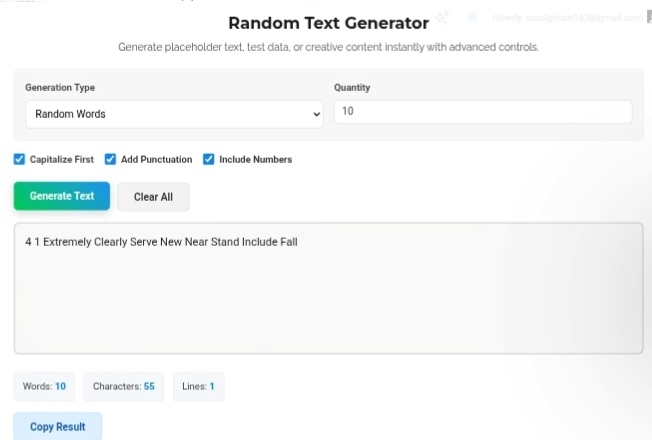
Let’s be real for a second. You’re staring at a blank page. Maybe it’s a website wireframe, maybe a brochure layout, or that mobile app screen you’ve been mocking up for hours. And there’s this awkward gap where the text should be. Your design looks… empty. Almost sad, honestly. That’s exactly when you realize you need something — anything — to fill that space without actually writing real content yet. Enter the Random Text Generator. Some folks still call it “Lorem Ipsum,” others just say dummy text. Whatever name you prefer, it’s basically a lifesaver when you’re deep in the creative zone.
So What Actually Is This Thing?
Okay, picture this: a tool that spits out paragraphs, sentences, or even full blocks of text that look like they mean something. But if you actually read them closely? Pure nonsense. Or at least, nothing you’d publish on your blog. For what feels like forever, designers have leaned on that classic Latin phrase — you know the one — “Lorem ipsum dolor sit amet…” It’s everywhere. But honestly? Modern tools have gotten way better. You can now generate actual English sentences, fake tech jargon that sounds impressively real, or even random dates and numbers if that’s what your layout demands. Way more useful than staring at Latin you don’t understand.
Why Bother With Placeholder Text Anyway?
Here’s the thing — and I learned this the hard way — when you’re tweaking fonts, adjusting margins, or obsessing over column widths, you need something on the page. Real text. But if you start writing actual meaningful content too early, your brain does this annoying thing where it starts reading instead of evaluating. Next thing you know, you’re editing the copy instead of the design. Dummy text solves that problem beautifully. It keeps your eyes focused purely on how things look, not what they say.
Oh, and developers? They use these generators for test data all the time. I mean, when you’re building an app or setting up a database, you can’t just leave fields empty. You need random inputs to see if the system breaks, handles edge cases, or just behaves weirdly. It’s not glamorous work, but it’s necessary.
Making It Work For You
Not all generators are created equal. The good ones let you customize everything:
Word Count Control: Need exactly 47 words for that headline? Done. 300 for a body section? Easy.
Format Options: Some tools give you raw HTML —
, whatever — so you can literally copy-paste into your code editor. Huge time saver. Special Characters: Throw in punctuation, numbers, or even random strings. Great for testing password fields or form validation. Case Sensitivity: Want everything uppercase? Lowercase? Title case? You got it.
Speed Up Your Process, Seriously
I used to type placeholder sentences by hand. “Sample text here.” “This is a placeholder.” Over and over. Such a waste of time. Once I started using a proper Random Text Generator, my prototyping speed basically doubled. You can instantly see how a layout shifts between mobile and desktop, catch spacing issues early, and present something polished to your client — all before the real content even exists. It’s one of those small workflow tweaks that makes a massive difference.
Bottom Line
Look, in digital design and development, being prepared isn’t just nice to have — it’s everything. Whether you’re a UI designer sketching out a dashboard at 2 AM or a developer debugging why that stupid form field won’t align properly, having a solid text generator ready to go is just… smart. Trust me on this one.
Go generate some dummy text for your next project. You’ll thank yourself later. https://seobricxtool.com/4843-2/
